



Tennis boasts a remarkably distinct scoring system. With intriguing terms like love, deuce, break point, and tiebreak, newcomers to the sport might find themselves puzzled.
This comprehensive guide will illuminate essential tennis scoring terminology, elaborating on their meanings and applications throughout a match.
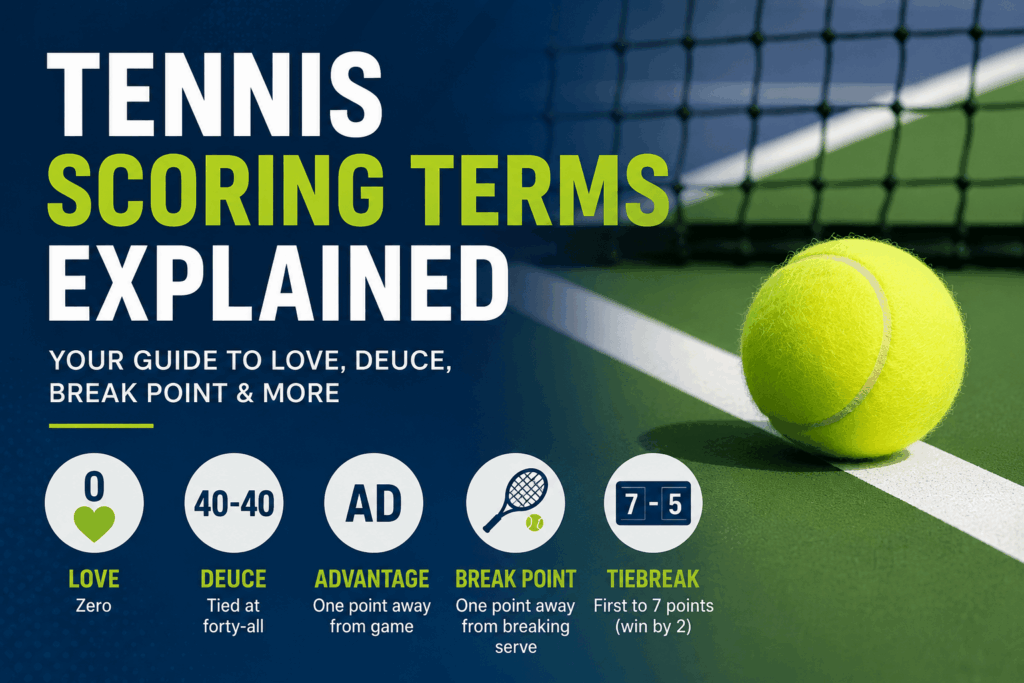
Understanding Tennis Scoring
A tennis match comprises:
- Points
- Games
- Sets
- Match
Players accumulate points to secure games, games to claim sets, and sets to win the match.
Fundamental Tennis Point Scoring
The classic tennis scoring sequence is as follows:
| Points Gained | Tennis Score |
|---|---|
| 0 | Love |
| 1 | 15 |
| 2 | 30 |
| 3 | 40 |
| 4 | Game (leading by two points required) |
For example:
- 15–0 means the server won the initial point
- 30–15 indicates the server has two points while the opponent has one
- 40–30 signifies the server is one point away from claiming the game
Key Tennis Scoring Terms
Love
In tennis, “love” signifies zero points.
Examples of usage:
- Love–15
- 30–Love
- Love–Love
The exact origin of this term remains a mystery, but it has been part of tennis scoring for centuries.
Deuce
Deuce arises when both competitors reach 40–40 in a game.
To win from deuce, a player must secure two consecutive points.
Advantage
Post-deuce scenarios include:
- Winning the next point grants the player an advantage
- Winning the subsequent point concludes the game
- If the next point is lost, the score resets to deuce
Illustrative examples:
- Advantage Federer
- Ad-In (server has the advantage)
- Ad-Out (receiver has the advantage)
Game
A player wins a game by securing at least four points, leading by two.
Example scores include:
- 40–15 → one point away from winning the game
- Advantage → on the verge of winning the game
Set
To clinch a set, a player must win at least six games with a two-game lead.
Should the score reach 6–6, a tiebreak typically ensues.
Match
Matches are generally played as:
- Best of 3 sets (common in ATP/WTA events)
- Best of 5 sets (used in men’s Grand Slam tournaments)
The player who wins the designated sets claims victory in the match.
Tiebreak
Tiebreaks determine a set when the score ties at 6–6.
Points are scored as usual, with the first player achieving 7 points while maintaining a two-point lead winning the tiebreak and the set.
Super Tiebreak
Often utilized in lieu of a final set during doubles matches and certain tournaments, the first player or team to reach 10 points while leading by two wins.
Break Point
A break point arises when the receiving player is a point away from claiming the game on the opponent’s serve.
Examples include:
- 30–40
- Advantage receiver
Breaking serve can be pivotal in a match, as serving generally offers a notable edge.
Service Break
A service break occurs when a player wins a game while their opponent is serving.
For instance:
If the score transitions from 2–2 to 3–2 after the receiver wins a game, they’ve accomplished a service break.
Hold Serve
Holding serve refers to winning your service game.
Players with strong serves typically have high hold percentages.
Double Fault
A double fault occurs when a player misses both serves on a single point, automatically resulting in the loss of that point.
Ace
An ace is a serve that the opponent fails to touch with their racket.
Power servers like John Isner and Ivo Karlović are well-known for their impressive ace counts.
Let
A let happens when:
- The serve grazes the net
- But still lands within the correct service box
The serve is replayed without consequences.
Unforced Error
An unforced error is a misplay made without significant pressure from the opponent.
Examples include:
- Missing an easy forehand shot
- Sending a simple volley into the net
Winner
A winner is a shot that lands in bounds and cannot be returned by the opponent.
Love Set
A love set refers to winning a set with a score of 6–0.
Example of a love set:
Bagel and Double Bagel
The term “bagel” refers to winning a set 6–0, drawing its name from the shape of a bagel which resembles the number zero. A “double bagel” indicates a score of 6-0 across both sets.
Breadstick
The term “breadstick” signifies a 6–1 set score.
Golden Set
A golden set occurs when a player wins an entire set without conceding a single point.
Such an achievement is incredibly rare in professional tennis.
Illustrative Tennis Scoring Example
Consider this example of how scoring unfolds within a game:
- Love–Love
- 15–Love
- 15–15
- 30–15
- 40–15
- Game
In case of a deuce scenario (40–40):
- Deuce
- Advantage Player A
- Deuce
- Advantage Player B
- Game Player B
Frequently Asked Questions
Why is tennis scoring 15, 30, 40?
The precise origins are unclear, but it’s believed to stem from old French clock-face scoring systems used in early versions of tennis.
What does “love” represent in tennis?
Love signifies zero points or zero games in tennis scoring.
What does deuce mean in tennis?
Deuce occurs when both players reach 40–40. A player must then win two consecutive points to secure the game.
What is a break point in tennis?
A break point signifies when the receiving player has an opportunity to win the server’s game by just one more point.
What differentiates a tiebreak from a super tiebreak?
A standard tiebreak is typically played to 7 points, whereas a super tiebreak is played to 10 points.
What does “holding serve” mean?
Holding serve means successfully winning your own service game.
What is a bagel in tennis?
A bagel refers to a set won with a score of 6–0.
What’s a golden set?
A golden set occurs when a player wins an entire set without conceding any points.